


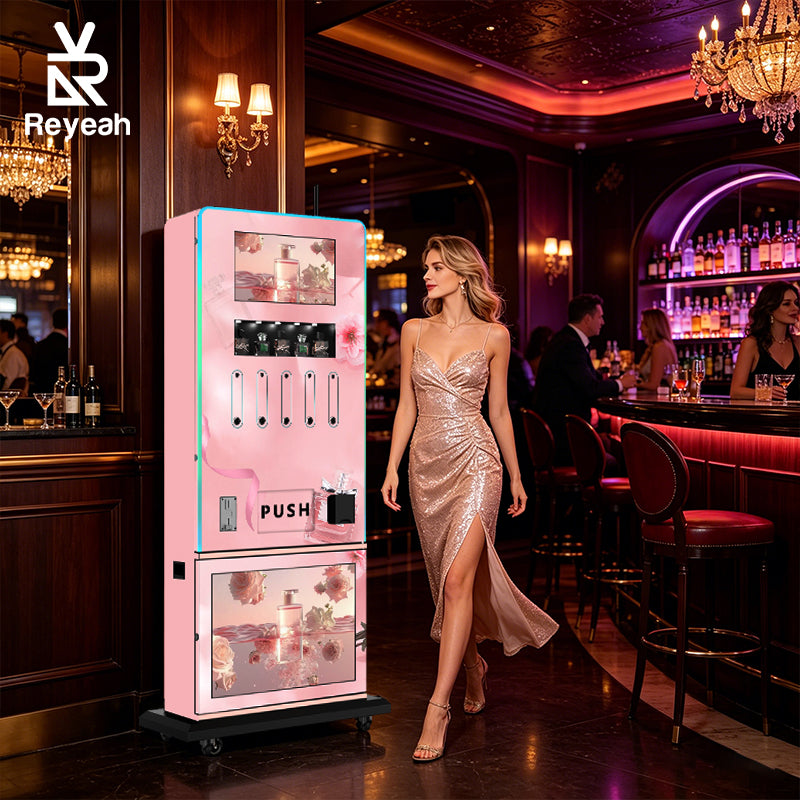


Two perfume vending machine quotes can look identical on page one and behave completely differently on site. The difference is almost always buried in the vending machine specifications sheet: nozzle count, spray volume, tank size, payment hardware. None of those numbers matters on its own — what matters is what each one does to your revenue per vend and your cost per spray. This guide walks the spec sheet line by line, in the order it affects your money.
1. Nozzle count: range, not capacity
Nozzle count is the first number every buyer looks at, and it is the most misunderstood. A 5-nozzle perfume vending machine carries five fragrances; a 10-nozzle machine carries ten. Neither number tells you how many vends a full tank supports — that is a function of tank volume and spray size, covered below.
What nozzle count actually buys you is range. More nozzles means a wider fragrance wall, which raises the chance that a passing shopper finds something they want to try. It also means more SKUs to stock, more partial bottles, and a longer refill cycle. In venues with the same crowd every day — an office lobby, a hotel floor — five well-chosen fragrances usually outperform ten poorly chosen ones. In high-footfall, high-variety venues such as malls and airports, ten nozzles earn their keep. Our 5 vs 10 nozzle comparison covers that trade-off in detail.
2. Spray volume per actuation: the number that sets cost per spray
Every machine dispenses a fixed volume each time a customer presses the button, typically somewhere between 0.05 ml and 0.2 ml. This single figure drives your unit economics more than any other spec, because it decides how many vends one bottle yields:
- A 100 ml bottle at 0.1 ml per vend yields about 1,000 vends.
- The same bottle at 0.2 ml yields about 500 vends.
Same bottle, same wholesale price, half the gross margin per vend. When a cost per spray model looks too good to be true, the spray volume is usually the reason. Ask for the volume in millilitres, not a vague “small, medium, large” setting, and confirm whether it is adjustable in software or fixed by the nozzle hardware.
3. Tank capacity and refill interval
Tank capacity is quoted in millilitres per channel. Combined with spray volume and expected daily vends, it gives you the only operational number that matters at this stage: days between refills.
Days between refills = tank volume ÷ (vends per day × spray volume). A 300 ml channel at 0.1 ml and 15 vends a day runs for 200 days before it is empty. The same channel at 60 vends a day runs for 50 days. If your refill interval is shorter than your restocking route, you will be driving back to the site for one channel — the most expensive visit in vending.
4. Footprint, power and environment
Check three physical numbers before you sign a venue agreement: cabinet dimensions, weight when fully loaded, and power draw. Weight matters because a fully stocked machine is far heavier than the shipping crate figure suggests, and upper floors or temporary floors may not take it. Power matters because some venues supply a single 10 A socket and nothing else.
Also confirm the operating temperature range. Fragrance is a volatile product; a machine placed next to a west-facing window or in an unheated corridor will see its spray behaviour and its fragrance quality change with the seasons. Ask whether the spec sheet's range is for the electronics only or for the liquid as well.
5. Payment and telemetry hardware
Payment is specified, not assumed. Confirm which of these the quote includes: card reader brand and model, contactless acceptance, QR or wallet support, coin and bill handling, and whether the reader is integrated into the machine's own board or bolted on afterwards. An aftermarket reader is cheaper up front and more expensive in reconciliation, because sales and payments live in two separate systems.
Telemetry is the other half. A cloud dashboard that reports sales per channel, stock level and fault status turns a machine you must visit into a machine you can watch. Confirm the SIM or connectivity cost, whether it is included in the price, and whether the data is exportable. Our maintenance and refill guide shows how the telemetry data is actually used on a route.
6. How to compare two quotes line by line
Put both sheets side by side and compare these six rows in this order: nozzles, spray volume in ml, tank volume in ml, payment hardware model, telemetry included or not, and warranty terms. Any quote that omits spray volume or tank volume is not a comparable quote — ask again before you negotiate price, because those two numbers are what you are really buying.
Reyeah machines ship with a one-year manufacturer warranty and lifetime remote technical support, with OEM/ODM front-panel branding available at order, so spec questions are answered against the exact configuration you are being quoted rather than a generic catalogue.
Conclusion
Specifications are not a checklist to tick off; they are the inputs to a profit model. Nozzle count sets your range, spray volume sets your cost per spray, tank capacity sets your refill interval, and payment plus telemetry set how much of the operation you can run remotely. Once you have those four numbers, put them into the cost and ROI calculator and see what the machine actually returns before you commit to a second unit.

Leave a comment