


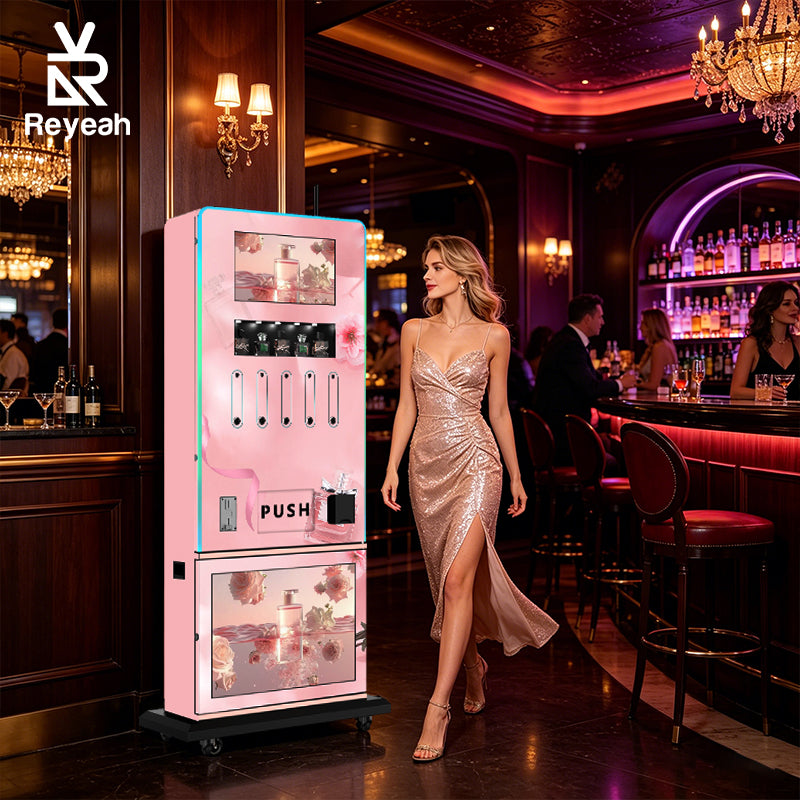


Short answer: budget for a landed cost, not a sticker price. A commercial-grade TCG card vending machine is typically the smallest line item once freight, duty, payment hardware, site commission and initial card stock are added. In most operator budgets we see, the machine itself lands at roughly 55–70% of first-year capital, and the rest is logistics, stock and venue costs. The number that decides whether the project works is not the machine price — it is gross profit per pack sold, multiplied by packs sold per day.
This breakdown shows the full cost stack, three realistic budget scenarios, and the payback math you can re-run with a real factory quote.
All currency figures below are illustrative planning inputs, clearly marked, so you can replace them with your own quote. Reyeah does not publish fixed retail prices because every unit is configured to order (channels, screen size, payment stack, branding).
What is actually included in the price of a TCG vending machine?
A quoted machine price usually covers the cabinet, dispensing mechanism, controller, screen and factory testing. It rarely covers:
| Cost line | What it is | Typical planning band (illustrative) | Paid to |
|---|---|---|---|
| Machine (FOB) | 24–48 channel card dispenser, screen, controller | 55–70% of landed cost | Factory |
| Export packing + freight | Sea LCL or air, crated | 8–15% | Freight forwarder |
| Duty + import VAT/GST | Country-specific tariff on vending machines | 0–25% of CIF | Customs |
| Last-mile + installation | Port to site, uncrating, levelling | 2–5% | Local handler |
| Payment terminal | Card reader / NFC module if not bundled | 1–4% | Payment provider |
| Initial card stock | Sealed booster packs, tins, slabs | 10–25% (venue-dependent) | Distributor |
| Site commission deposit | First month revenue share, if required | 0–1 month revenue | Landlord |
| Spares + tools | Nozzles/lanes, fuses, cleaning kit | 1–2% | Factory |
| Insurance rider | Contents + liability at the site | annual, low four figures | Insurer |
Two lines surprise first-time operators most: duty classification and initial stock. A machine that dispenses 24 facings needs enough sealed product to fill every lane before it can earn — and card product is bought at wholesale, not retail.
How does the machine configuration change the price?
Price moves with four variables, in roughly this order of impact:
- Channel count. A 24-channel floor unit and a 48-channel unit use different shelf structures, motors and cabinet volumes. More channels means more SKUs merchandised, but also more capital tied up in stock.
- Screen size and interactivity. A 43" networked touchscreen with an Android controller is a materially different bill of materials than a button panel. It also unlocks ad revenue and pack-selection animations.
- Payment stack. A single card reader is cheap; a multi-currency bill validator + coin acceptor + NFC + telemetry gateway is not. If you operate across borders, specify the stack up front — retrofitting is expensive.
- OEM/ODM branding. Full-body vinyl wraps, illuminated logo toppers and custom UI are one-off tooling and design costs, not per-unit hardware. Ordering branding with the first batch is far cheaper than adding it later.
Cabinet gauge, lock grade and anti-jam engineering are the variables buyers under-specify. A cheap cabinet that flexes will mis-align lanes and produce jams — the most expensive failure mode in card vending, because a jammed lane is invisible revenue loss.
What does a realistic first-year budget look like?
Three illustrative scenarios. Replace the machine and freight lines with your actual quote.
| Scenario A: single unit, hobby shop | Scenario B: 5-unit route | Scenario C: mall flagship | |
|---|---|---|---|
| Configuration | 24 channels, 43" screen | 24 channels, no screen or small screen | 48 channels, glass showcase, side touchscreen |
| Machines | $6,500 | $27,500 (5 × $5,500) | $9,500 |
| Freight + duty + install | $1,800 | $7,500 | $2,400 |
| Payment hardware | $450 | $1,800 | $600 |
| Initial stock | $1,200 | $6,000 | $2,500 |
| Spares, insurance, misc. | $650 | $2,200 | $900 |
| Year-1 capital | $10,600 | $45,000 | $15,900 |
Scenario B is cheaper per unit because freight, spares and setup are shared. Scenario C costs more per unit but is designed to sell higher-ticket items — booster boxes, tins and graded slabs — where margin per transaction is larger.
How do you calculate payback on a card vending machine?
Use contribution per pack, not margin percentage:
Contribution per pack = Retail price
                      − Wholesale cost
                      − Payment + telemetry fees (% of sale)
                      − Site commission (% of sale)
Worked example (illustrative inputs — substitute your own):
| Input | Value |
|---|---|
| Average pack retail | $4.99 |
| Wholesale cost per pack | $2.80 |
| Payment + telemetry | 3.5% → $0.17 |
| Site commission | 12% → $0.60 |
| Contribution per pack | $1.42 |
Monthly fixed costs (connectivity, insurance, spares reserve): ~$60 → ~$2/day.
| Packs sold per day | Contribution/day | Payback on $7,000 landed unit |
|---|---|---|
| 20 | $28.40 | ~8 months |
| 40 | $56.80 | ~4 months |
| 80 | $113.60 | ~2 months |
The lesson: payback is a traffic function, not a hardware function. Spending $2,000 more on a machine that raises sell-through by 15% beats saving $2,000 on a unit that jams twice a month.
Which hidden costs actually matter?
- Shrinkage and theft. Glass-front card machines are magnets for break-in attempts. Specify reinforced cold-rolled steel, tamper-resistant tempered glass, electronic locks and a drop sensor that verifies delivery — then confirm the site's overnight security.
- Jam-driven lost sales. There is no error message for "lane 7 has been empty for three days." Telemetry with per-channel low-stock alerts is not a luxury; it is the difference between 85% and 98% in-stock rates.
- Payment fees. 2.5–4% of every sale plus terminal rental. On $4.99 packs this is a real margin line.
- Stock obsolescence. Card sets rotate. Slow lanes are dead capital — plan to re-merchandise monthly, and keep the top 20% of SKUs in the highest-visibility channels.
- Compliance. Business licence, sales tax registration and, in some jurisdictions, rules on selling sealed "mystery" product. Confirm locally before launch.
What should you ask a factory before comparing quotes?
Ask every supplier the same eight questions, or the quotes will not be comparable:
- Channel count, lane width range and maximum pack thickness.
- Anti-jam mechanism: optical drop sensor, spring pitch, cushioned collection bin?
- Screen size, OS, and whether content can be updated remotely.
- Payment stack supported (which reader brand, which currencies, NFC?).
- Connectivity: 4G, Wi-Fi, Ethernet — and what the telemetry subscription costs after year one.
- Certification (CE and local equivalents) and warranty terms, including what is excluded.
- Spare parts lead time and whether a spares kit ships with the first order.
- OEM/ODM terms: artwork files, tooling cost, minimum order for custom wraps.
A factory that answers all eight in writing, with part numbers, is a factory you can hold to a delivery date.
How Reyeah configures card machines
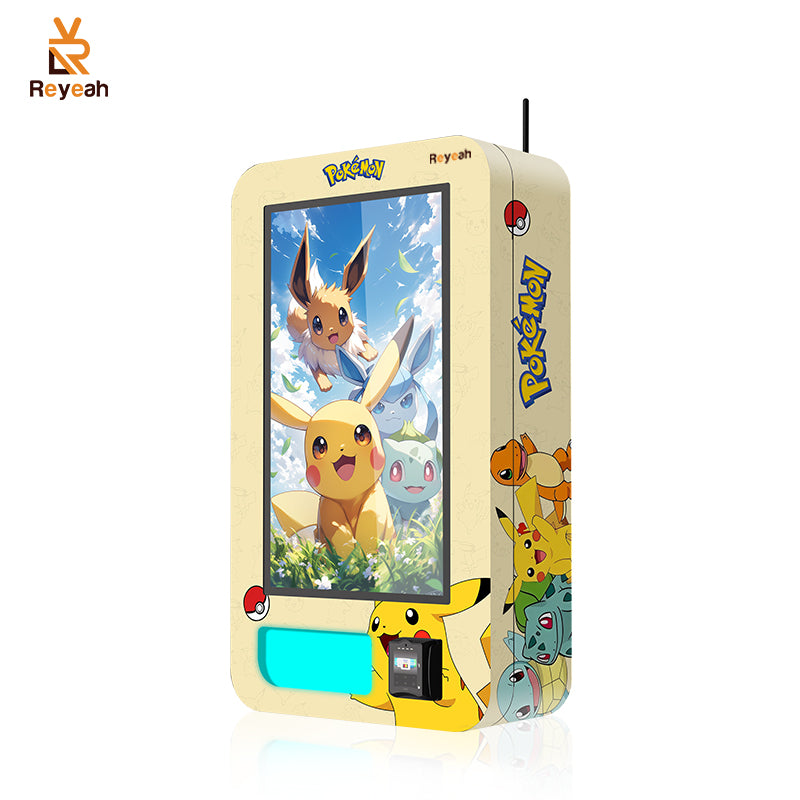
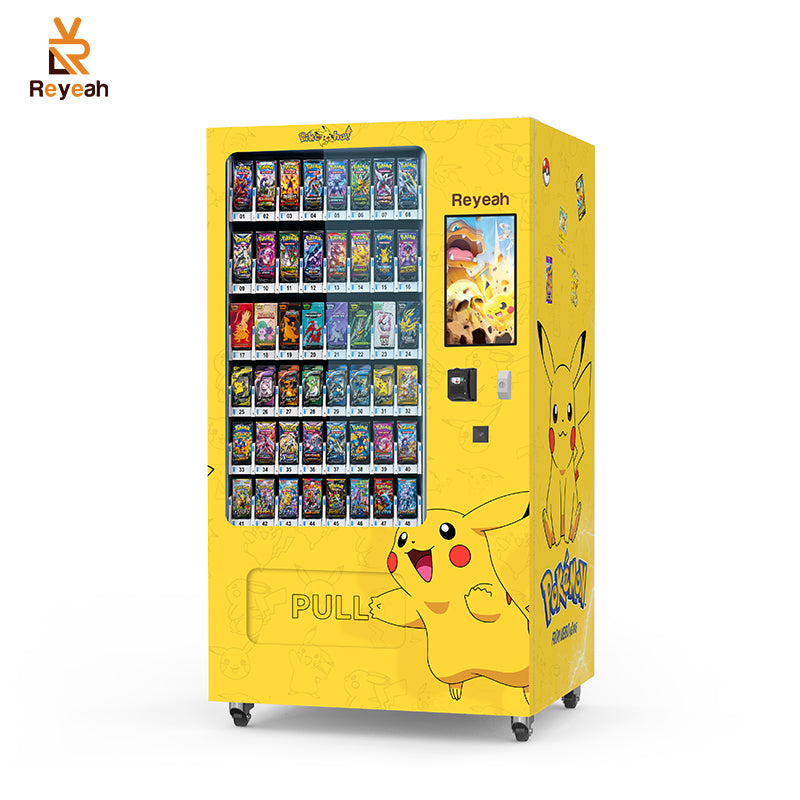
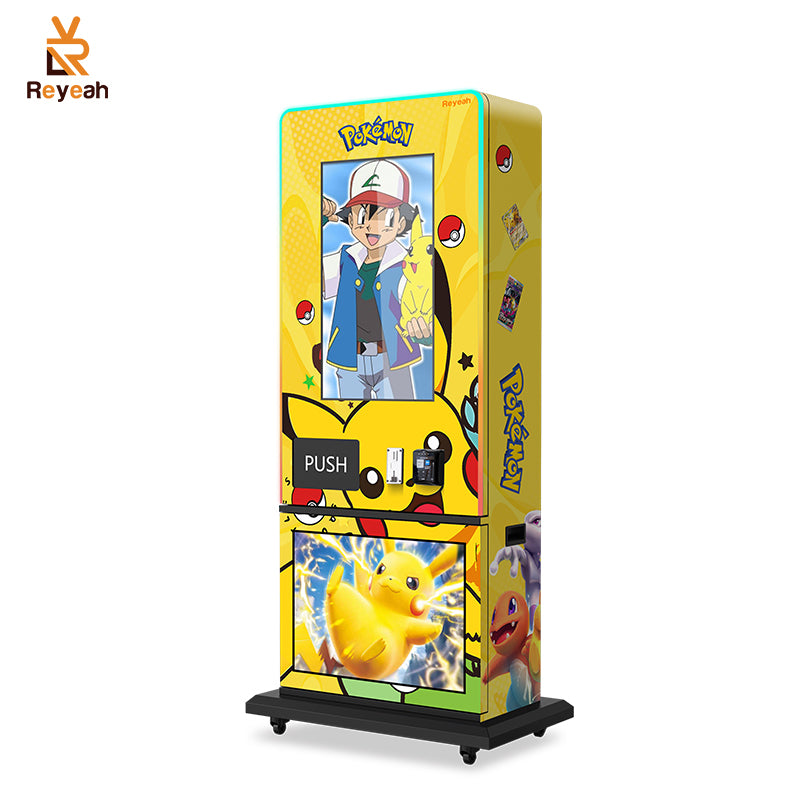
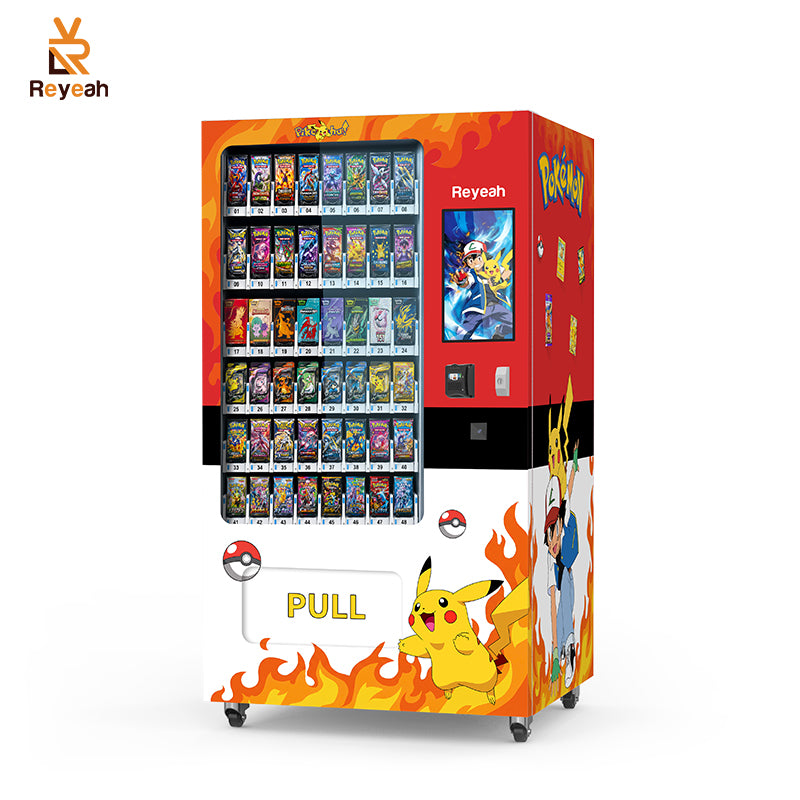
Reyeah builds TCG card vending machines at its Guangzhou factory — 15+ years in vending, 100,000+ machines produced per year, 300+ patents and a 50-engineer R&D team. The card range spans a 24-channel 43" floor unit (TCG-11), a 48-channel glass-showcase model with a side touchscreen (CUZ016), an ultra-slim wall unit (G02) and a slim dual-screen floor kiosk (D12). All support Nayax/Cantaloupe cashless readers, multi-currency bill and coin acceptors, 4G/Wi-Fi/Ethernet telemetry, and full OEM/ODM exterior branding, with a 1-year warranty and lifetime technical support.
Because units are configured to order, the honest answer to "how much" is: send your channel count, payment markets and venue type, and you get a line-item quote instead of a range. Request a factory-direct quote.
FAQ
Is a TCG card vending machine profitable? It can be, because card product carries higher gross margin than snack and drink vending. Profitability depends on sell-through: at a contribution of roughly $1.40 per pack and 40 packs per day, a $7,000 landed unit pays back in about four months. At 10 packs per day, the same unit takes over a year.
How much does a Pokémon card vending machine cost? Pokémon is the most common product mix, but the machine is the same hardware category. Cost is driven by channel count, screen and payment stack, not by the brand of cards you load. Expect the machine to be the smaller half of the first-year budget once freight, duty and initial stock are included.
Do I need a 24-channel or 48-channel machine? Under about 15 active SKUs, 24 channels is right. Once you merchandise booster boxes, tins, accessories and slabs alongside packs, 30+ SKUs is normal and a 48-channel unit prevents constant re-merchandising. See the configuration comparison.
What payment methods should the machine accept? Card and NFC (Apple Pay, Google Pay) cover most of the market; keep bill and coin acceptance where cash use remains high, such as transit and event venues. Specify the stack before production — retrofitting a validator is more expensive than ordering it.
How much does shipping add? Sea LCL is the default for single units and small routes; air freight is used when a venue opening date is fixed. Freight, duty and last-mile together commonly add 10–20% to the FOB price depending on destination and Incoterm.
What warranty comes with a commercial card vending machine? Reyeah units ship with a 1-year factory warranty and lifetime remote technical support. Consumables and wear parts — lane springs, nozzles, belts — are typically excluded, which is why a spares kit belongs in the first order.
Can the machine be branded for my store or arcade? Yes. Full-body vinyl wraps, illuminated logo toppers, header signage and custom touchscreen UI are available as OEM/ODM options. Artwork and tooling are one-off costs, so order them with the first batch.
How long does delivery take? Production and shipping time depend on configuration and destination; the binding number is the delivery date on your proforma invoice. Ask for it in writing, with the vessel or flight booking, before paying a deposit.
Sources
- Circana, "U.S. Toy Industry Returns to Growth in 2025" (3 Feb 2026) — Pokémon reached $2.5B in U.S. sales, +87% year over year; Games & Puzzles grew 37%, driven primarily by Pokémon: https://finance.yahoo.com/news/u-toy-industry-returns-growth-170500214.html
- PSA, "Grading Standards" — grading criteria and centering tolerances relevant to slab merchandising: https://www.psacard.com/gradingstandards
Figures in the cost tables are illustrative planning inputs, not a Reyeah quote. Configuration, destination and payment markets determine the actual price.
Leave a comment