


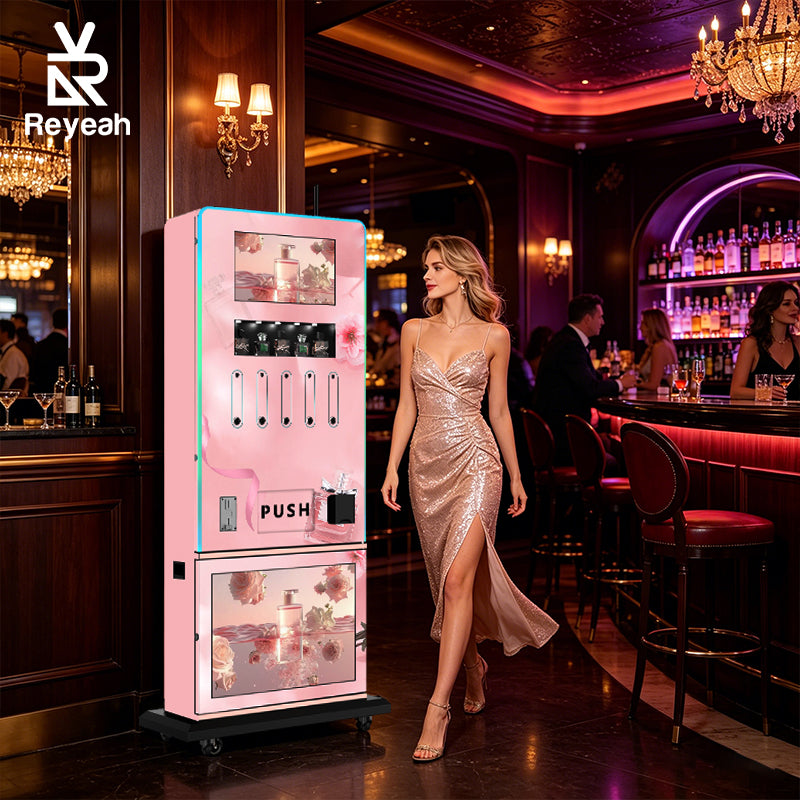


Short answer: a perfume vending machine earns money per spray, not per bottle, and the whole business case rests on one number — the cost of the fragrance volume you dispense. At the factory default of 0.13 ml per spray, a fragrance bought at $0.30/ml costs about $0.039 per vend. Sell that spray for $2.00 and you keep roughly $1.89 before site commission and payment fees. A 100 ml bottle yields about 769 sprays at that dosage, which is why refill cost is a rounding error next to location quality.
Below: the full cost stack, a dosage cost table, payback math at four traffic levels, and the four miscalculations that make new operators overestimate profit.
Currency figures are illustrative planning inputs. Reyeah configures every machine to order, so the machine price comes from a quote, not a list.
What does a perfume vending machine cost?
Price is set by four variables, not by the brand of fragrance:
| Variable | Effect on price |
|---|---|
| Nozzle count (5 vs 10) | More pumps, valves and channels; higher bill of materials |
| Interface (buttons vs touchscreen vs HD ad screen) | Screen size and Android controller are a material cost |
| Mounting (wall vs floor cabinet) | Floor units carry more steel, larger reservoirs, castors |
| Payment stack | Card reader alone vs card + NFC + bill + coin |
Budget the machine as roughly half of first-year capital. The rest is freight, duty, installation, initial fragrance inventory and spares. A single wall unit typically has a smaller all-in position than a floor flagship, even before site costs.
What does one spray cost you?
Fragrance cost per spray = (bottle price ÷ bottle volume in ml) × spray volume in ml.
The Reyeah perfume range supports five calibrated doses — 0.02, 0.04, 0.13, 0.20 and 0.23 ml — with 0.13 ml set as the factory default after testing. At an illustrative fragrance cost of $0.30/ml:
| Dose | Fragrance cost per spray | Sprays per 100 ml bottle | Revenue at $2.00/spray | Gross profit per bottle |
|---|---|---|---|---|
| 0.02 ml | $0.006 | 5,000 | $10,000 | $9,970 |
| 0.04 ml | $0.012 | 2,500 | $5,000 | $4,970 |
| 0.13 ml (default) | $0.039 | 769 | $1,538 | $1,508 |
| 0.20 ml | $0.060 | 500 | $1,000 | $970 |
| 0.23 ml | $0.069 | 435 | $870 | $840 |
The table makes the core tension visible: lower dosage multiplies theoretical margin but destroys perceived value. A 0.02 ml mist is barely detectable on skin; customers do not re-buy what they cannot smell. 0.13 ml is the compromise the factory settled on — enough coverage to be a real fragrance experience, low enough that refill cost stays under 4% of a $2.00 vend.
What is the real contribution per spray?
Gross margin per bottle is not what pays the bills. Contribution per vend is:
Contribution = Price per spray
             − Fragrance cost
             − Payment + telemetry fee (% of price)
             − Site commission (% of revenue)
Worked example at $2.00 per spray, 0.13 ml, $0.30/ml fragrance:
| Line | Amount |
|---|---|
| Customer pays | $2.00 |
| Fragrance | −$0.039 |
| Payment + telemetry (3.5%) | −$0.070 |
| Site commission (15%) | −$0.300 |
| Contribution | $1.59 |
Drop the commission (own venue, or a flat-fee site) and contribution rises to $1.89 — a 19% difference on the same hardware, which is why site terms matter more than machine spec.
How fast does a machine pay back?
Illustrative: $3,500 landed single wall unit, 0.13 ml dose, $2.00 price, $1.59 contribution.
| Sprays per day | Contribution/day | Payback |
|---|---|---|
| 20 | $31.80 | ~110 days |
| 30 | $47.70 | ~73 days |
| 50 | $79.50 | ~44 days |
| 80 | $127.20 | ~28 days |
Compare that with card vending: perfume economics are driven by transactions, not basket size. The machine either sits where people have a reason to freshen up — before a date, after a workout, on the way into a venue — or it does not sell.
Which costs do new operators forget?
- Site commission. A 15% revenue share is $0.30 on every $2.00 vend. On 1,000 vends a month that is $300 — often more than the electricity and connectivity combined.
- Fragrance inventory, not just refill cost. Ten nozzles means ten open bottles. Slow-moving scents oxidise before they sell, and dead stock is a real loss.
- Priming loss on refill. Every refill introduces a small volume of air into the line that must be purged. Ask the factory for the priming volume per channel and include it in your refill cost.
- Downtime. A clogged nozzle on a Saturday night is not a deferred sale; it is a lost one. At 30 sprays/day and $2.00, a two-day outage costs $120 plus the customer who does not come back.
Monthly fixed costs are modest — connectivity, a spares reserve, insurance — typically well under $100 for a single unit. The variable that decides profitability is vends per day.
How should you price a spray?
Price should follow venue willingness-to-pay, not fragrance cost:
| Venue type | Typical price band (planning) | Rationale |
|---|---|---|
| Nightclub / bar restroom | $2.00–3.00 | Captive audience, late-night occasion |
| Gym / fitness club | $1.00–1.50 | Frequent, low-ticket, habitual |
| Mall corridor | $1.50–2.50 | Comparison with retail testers nearby |
| Hotel lobby / airport | $2.00–3.00 | Traveller without their bottle |
| Casino / entertainment complex | $2.00–3.00 | Disposable income, night economy |
At 0.13 ml and $1.00, contribution drops to roughly $0.78 after a 15% commission — still healthy, but payback more than doubles. Under-pricing is a common error in gyms, where operators assume a low price drives volume; in practice the constraint is dwell time, not price.
How do 5 and 10 nozzles change the economics?
More nozzles do not change cost per spray — they change assortment and restock labour.
- 5 nozzles: lower fragrance capital, faster restock, easier to keep every channel fresh. Best where the audience is broad and one or two scents dominate (restrooms, gyms).
- 10 nozzles: wider choice drives conversion in venues where customers compare — malls, hotels, airports. Restocking ten bottles takes roughly double the time, and slow channels must be rotated or they oxidise.
The full model-by-model breakdown is in the perfume machine buying guide.
What should be in the purchase quote?
Ask for these lines in writing so the economics are comparable:
- Nozzle count and reservoir volume per channel
- Calibrated dosage range and factory default (ml per spray)
- Pump type, anti-leak specification and priming volume
- Payment stack: reader brand, NFC, bill/coin acceptance, currencies
- Connectivity and telemetry subscription cost after year one
- Power draw (110–240 V input on Reyeah wall units) and standby consumption
- Warranty scope, wear-part list and spares lead time
- OEM/ODM options: front panel branding, colour finish, nozzle calibration
Reyeah builds five- and ten-nozzle perfume machines at its Guangzhou factory — 15+ years in vending, 100,000+ machines per year, 300+ patents — with Nayax/Cantaloupe cashless payment, 4G/Wi-Fi telemetry, custom front-panel branding, a 1-year warranty and lifetime technical support. Request a factory-direct quote.
FAQ
How much does a perfume vending machine cost? It depends on nozzle count, interface, mounting and payment stack, so factories quote per configuration rather than publish a list price. Budget the machine at roughly half of first-year capital once freight, duty, initial fragrance and spares are included.
How much profit is there per spray? At a 0.13 ml dose with fragrance at $0.30/ml, the fragrance costs about $0.039. At a $2.00 price with a 15% site commission and 3.5% payment fees, contribution is roughly $1.59 per spray.
How many sprays are in a 100 ml bottle? About 769 at 0.13 ml per spray, 2,500 at 0.04 ml, and 435 at 0.23 ml. Dosage is the single biggest lever on refill cost — and on whether customers perceive the spray as value.
Is 0.13 ml enough fragrance to smell? It is the factory default after dispensing tests, chosen to give usable coverage while keeping refill cost a small share of the vend price. If your venue skews to premium fragrance, a lower dose with a higher price can work — test before committing every channel.
Can I use my own fragrance brand in the machine? Yes. The machines are refillable, and operators commonly load their own or a partner brand's juice. Label the unit in line with local cosmetic and consumer rules, and keep refill records — brand partners will ask for them.
Do I need a licence to operate a perfume vending machine? Usually a general business licence plus site permission; retail sale of cosmetic product may carry labelling and tax obligations. Confirm the specifics with your local authority — requirements differ by country and, in federal systems, by state.
How much does the machine cost to run? Power draw is low and continuous, and connectivity is a small monthly line. On a single unit, running costs are typically well under $100 a month excluding fragrance and site commission.
What is a realistic payback period? On a $3,500 landed unit at 30 sprays per day and $1.59 contribution, payback is roughly 73 days. At 20 sprays per day it stretches past three months; at 80 it approaches one month. Vends per day is the variable that matters.
Sources
- Circana, "US Prestige Beauty Industry Sales Grow by 8% in the First Half" (6 Aug 2024) — fragrance was the fastest-growing prestige category, +12% in H1 2024, with mini and travel sizes growing at twice the category rate: https://www.circana.com/post/us-prestige-beauty-industry-sales-grow-by-8-in-the-first-half-circana-reports
- Reyeah product documentation — calibrated dosage range 0.02–0.23 ml, factory default 0.13 ml: https://www.gzreyeah.com/
Dosage, pump and reservoir specifications are Reyeah factory specifications. Price, fragrance cost and commission figures are illustrative inputs for planning.
Leave a comment