


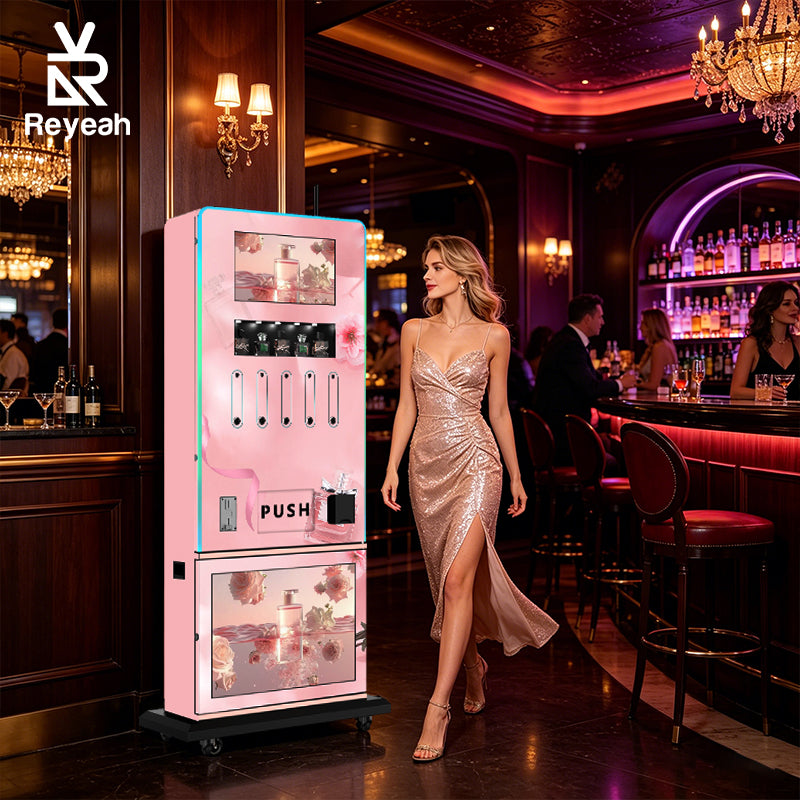


Short answer: perfume vending machines fail in three predictable ways — a clogged nozzle, a dry line after refill, and a payment fault. All three are preventable with a 5-minute daily check, a 20-minute weekly service and a disciplined refill routine. The cost of skipping them is not a repair bill; it is lost vends at the busiest hour, plus the customer who does not come back.
This playbook gives the maintenance schedule, the refill procedure, clog root causes, a troubleshooting matrix and the spare-parts list a route operator should hold. It applies to the Reyeah P02, P02 PRO, CUZ-024, P03, P12 and P13, all of which use calibrated micro-atomisation nozzles across a 0.02–0.23 ml dose range.
What is the maintenance schedule?
| Frequency | Task | Time | Why it matters |
|---|---|---|---|
| Daily | Wipe nozzle tips, check drip tray, confirm every channel sprays once, check stock levels | 5 min | Dried concentrate at the tip is the number-one clog cause |
| Weekly | Purge each line, clean the cabinet front and screen, test card and coin acceptance, empty waste | 20 min | Catches weak spray before customers do |
| Monthly | Deep-clean nozzles, inspect seals and tubing, review per-channel sales, reprice slow channels | 45 min | Restores flow consistency and fixes assortment drift |
| Quarterly | Replace worn nozzles and seals, update firmware, back up configuration, audit power and network | 1–2 hrs | Wear parts fail gradually, then all at once |
| Annually | Full service: pump calibration check, cabinet security check, insurance and permit review | half day | Keeps dosing accuracy — the margin line — inside tolerance |
Print it and tape it inside the service door. A schedule that lives in a phone is a schedule that gets skipped.
Why do nozzles clog?
Five causes, in order of frequency:
- Dried residue at the nozzle tip. Fragrance is solvent plus aromatic compounds; the volatile fraction evaporates and leaves a film. A channel that goes 48 hours without a vend dries shut.
- Air in the line after refill. The pump pulls air instead of liquid, produces a weak or absent spray, and the customer reads it as an empty machine.
- Oil-heavy or high-viscosity formulas. Some concentrations atomise less readily; they need a slightly larger dose or a different nozzle specification.
- Dust and lint in the cabinet. Ventilation pulls dust into the nozzle surround; it accumulates on the tip.
- Wrong cleaning fluid. Water in a fragrance line separates, leaves mineral residue and can attack seals. Use only the cleaning fluid specified by the factory.
The prevention is mechanical, not chemical: exercise every channel every day. A one-second test spray keeps the tip wet and the line primed, and it takes under a minute for a five-nozzle unit.
How do you clean a perfume vending machine?
Use the factory procedure for your model. The sequence, in general terms:
- Isolate the channel in the service menu so no customer can trigger a vend mid-service.
- Remove the reservoir and cap it; do not leave an open bottle in the cabinet.
- Flush the line with the specified cleaning fluid using the maintenance cycle — never push water through the pump.
- Soak the nozzle for the period stated in your manual, then dry it with a lint-free cloth. Do not probe the orifice with wire; the atomisation pattern depends on the orifice geometry.
- Refit and prime, then run three test sprays and confirm an even mist, not a jet or a drip.
- Log the service — date, channel, action, parts replaced. Warranty claims and brand partners both depend on this record.
If a nozzle still sprays unevenly after a flush and soak, replace it. Nozzles are consumables; diagnosing a $6 part for an hour is a false economy.
What is the correct refill procedure?
Refilling is where operators create their own downtime. Follow a fixed sequence:
- Match the batch. Record brand, scent name, lot code and volume for each channel. Do not top up a channel with a different lot unless you note it — scent consistency is the product.
- Fill to the marked level, not to the brim. Leave headroom for thermal expansion; overfilled reservoirs weep into the cabinet.
- Cap and seat the reservoir, checking the seal and the pickup tube depth.
- Prime the line using the maintenance menu until the spray is continuous.
- Run a test vend on every refilled channel before closing the door. This single step prevents most "empty machine" complaints.
- Record the refill and the priming volume used, so fragrance cost per vend stays accurate.
Keep a small refill kit on the route: funnel, lint-free cloths, gloves, labels, spare reservoir caps and a sealed bottle of cleaning fluid.
How should fragrance be stored?
- Cool and dark. Heat and UV accelerate oxidation; a closed cabinet in direct sun is the worst case.
- Sealed and full. Air in a half-empty bottle is the enemy. Decant into smaller containers rather than storing a large bottle at 20% fill.
- Away from odour. Fragrance absorbs surrounding smells — never store next to cleaning chemicals or in a stockroom with solvents.
- Rotate stock. First in, first out, with the lot code visible on the label.
- Watch for change. A colour shift, a sour or sharp top note, or visible sediment means the batch is past its usable life. Pull it before a customer does.
Shelf life varies by formula — citrus-forward compositions fade faster than resinous ones. Ask your fragrance supplier for the specific shelf life and retest interval; do not generalise across scents.
What does downtime actually cost?
Run the arithmetic once and the maintenance schedule stops feeling optional:
| Metric | Value (illustrative) |
|---|---|
| Spray price | $2.00 |
| Vends per day | 30 |
| Revenue per day | $60 |
| Two-day nozzle outage | $120 lost |
| Weekend outage in a nightlife venue | 60–90 vends lost |
| Contribution lost over a year of monthly outages | $1,400+ |
Add the harder cost: a customer who gets a dry spray at 1 a.m. does not try again. Reliability is the product.
How does telemetry reduce maintenance visits?
Cloud telemetry turns maintenance from calendar-driven to condition-driven:
- Per-channel depletion alerts show which nozzle is running dry, so refills are targeted rather than blanket.
- Failed-vend logs separate a mechanical fault from a payment fault before you drive to the site.
- Revenue by channel identifies the slow lane that should be re-merchandised instead of refilled.
- Remote price and content updates remove a site visit entirely for promo changes.
Set alert thresholds deliberately: a low-stock alert at 20% remaining gives enough lead time for a weekly route; at 5% it is already too late on a Friday night.
What spare parts should a route hold?
For a five- to ten-unit route, keep on hand:
| Part | Quantity | Notes |
|---|---|---|
| Atomisation nozzles | 5–10 | Model-specific; the most-replaced part |
| Nozzle seals / O-rings | 20 | Cheap, and a leaking seal ruins a cabinet |
| Reservoir caps and pickup tubes | 5 each | Lost caps stop a channel |
| Cleaning fluid | 2 bottles | Factory-specified only |
| Fuses | 5 | Match the rating printed on the label |
| Payment terminal spare | 1 | Swap-and-repair beats waiting for a shipment |
| Door lock key / spare lock | 1 set | Access failure is a total outage |
Order spares with the machine. Freight on a later parts order usually costs more than the parts.
Troubleshooting matrix
| Symptom | Likely cause | First fix | Escalate if |
|---|---|---|---|
| No spray, pump runs | Air in line / empty reservoir | Refill and prime | Pump runs dry after priming |
| Weak, uneven mist | Partial clog or worn nozzle | Flush, soak, test | Still uneven after replacement |
| Dripping from nozzle | Seal or valve wear | Replace seal and nozzle | Cabinet shows residue after replacement |
| Wrong scent dispensed | Reservoir mis-mapped | Re-label and re-seat channels | Mapping resets after power cycle |
| Card declined repeatedly | Reader connectivity | Check network, restart reader | Reader offline after restart |
| Screen frozen | Controller or content loop | Power cycle, reload content | Recurs within a week |
| Vend charged but nothing dispensed | Drop/spray sensor fault | Check sensor, refund via telemetry | Sensor fails repeatedly |
Any fault that recurs twice in a month is a design or site problem, not bad luck. Report it to the factory with the telemetry log — that is what the warranty process needs.
What does the factory support include?
Reyeah machines ship with a 1-year manufacturer warranty and lifetime remote technical support, and the service documentation covers nozzle replacement, priming procedure and payment configuration. Because units are configured to order — nozzle count, dosage calibration, payment stack, branding — the service manual matches the machine you received, not a generic model.
For operators running mixed estates (perfume plus card machines), both ranges report into the same cloud dashboard, which means one maintenance route and one set of alerts. See the perfume range for the model that matches your venue, and keep the spares list above on the route.
FAQ
How often should a perfume vending machine be cleaned? Wipe nozzle tips and test every channel daily; purge lines and clean the cabinet weekly; deep-clean nozzles and inspect seals monthly. Quarterly, replace worn nozzles and seals.
Why is my perfume vending machine spraying weakly? Usually air in the line after a refill, or a partial clog at the nozzle tip. Refill and prime first; if the mist is still uneven, flush and soak the nozzle, then replace it if the pattern does not recover.
Can I use water to clean the fragrance line? No. Water separates from fragrance, leaves mineral residue and can damage seals. Use only the cleaning fluid specified by the factory.
How much fragrance is wasted when refilling? A small priming volume per channel is normal, because the line must be purged of air. Ask the factory for the priming volume for your model and include it in your fragrance cost per vend.
What is the shelf life of fragrance in a machine? It depends on the formula — citrus-forward scents fade faster than resinous ones. Ask your supplier for the specific shelf life, store bottles cool, dark and sealed, and rotate slow channels rather than leaving them for months.
Do I need to test every channel after refilling? Yes. A single test vend per refilled channel catches air locks and mis-seated reservoirs before a customer does, and it takes seconds.
How long does a nozzle last? It is a wear part, not a lifetime component. Life depends on dosage, fragrance type and vends per day; keep spares on the route and replace at the first sign of an uneven spray pattern.
Can maintenance be done remotely? Diagnosis can. Telemetry reports failed vends, depletion and payment faults, so you arrive knowing which channel to service. Physical cleaning and refilling still require a site visit.
Sources
- Circana, "US Prestige Beauty Industry Sales Grow by 8% in the First Half" (6 Aug 2024) — fragrance was the fastest-growing prestige category at +12%, with mini and travel formats growing at twice the category rate, underscoring sampling and trial demand: https://www.circana.com/post/us-prestige-beauty-industry-sales-grow-by-8-in-the-first-half-circana-reports
- Reyeah product documentation — nozzle, dosage and telemetry specifications: https://www.gzreyeah.com/collections/perfume-vending-machines
Service intervals are recommended practice. Follow the service manual supplied with your specific configuration, and confirm warranty terms with the factory before replacing parts.

Leave a comment