






Short answer: most commercial perfume vending machines are built in Guangdong, but "manufacturer" covers two very different businesses. One designs the atomizer, the pump and the dosage calibration and owns patents on them; the other buys those assemblies and bolts them into a cabinet. For a perfume machine the first matters more than for any other vending category, because the product is a fine mist dispensed through a nozzle that clogs, drips or mis-doses if the fluid path was not engineered. Vet the fluid path first, the cabinet second, and compare suppliers on ten written lines.
This guide covers how the Chinese perfume vending machine supply chain is organized, which companies build which formats, what a factory has to engineer beyond sheet metal, and the comparison matrix that makes two quotes genuinely comparable.
Why are most perfume vending machines manufactured in China?
Because the components that make a perfume vending machine work — micro-diaphragm pumps, atomizer nozzles, food-grade and fragrance-compatible tubing, small tanks, touch panels, controllers and coin validators — sit inside one industrial cluster. A perfume vending machine is a fluid-handling device with a payment terminal attached, not a cabinet with a bottle inside. The cluster is what allows a factory to iterate on nozzle geometry and pump calibration in days rather than months.
The same cluster also produces assemblers who buy the fluid path as a module. That is why two perfume vending machines with identical exterior dimensions can behave completely differently after six months: one was engineered around the mist, the other around the cabinet.
Which companies manufacture wall-mounted and floor-standing perfume vending machines?
Most perfume vending machine manufacturers build one format and the other, because the fluid path is shared and only the housing and mounting change. What differs is which format each factory has actually engineered for volume:
| Format | Typical channel count | Where it is used | What to verify |
|---|---|---|---|
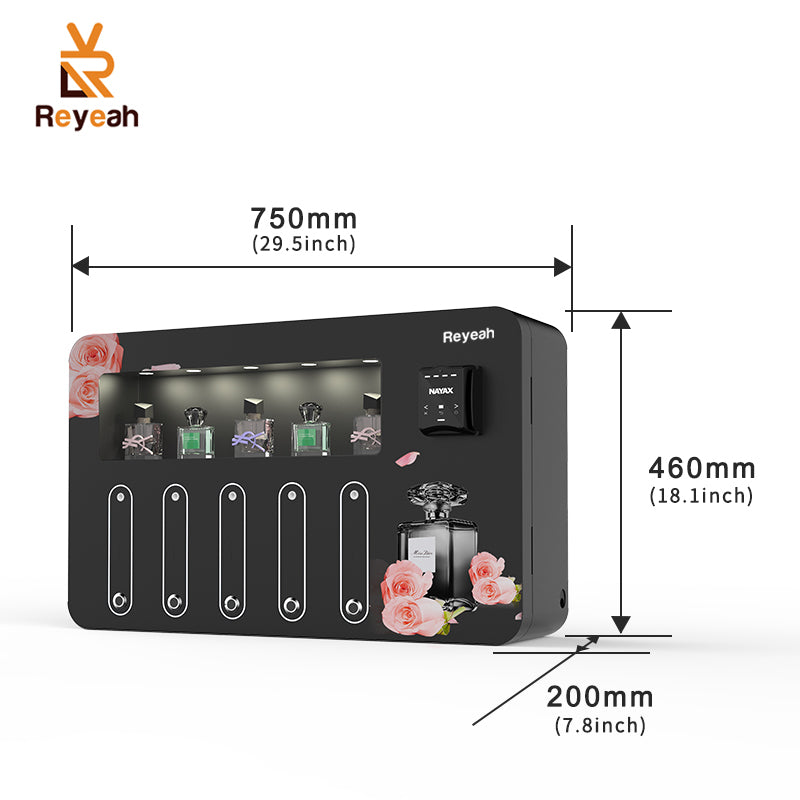
| Wall-mounted, screenless push-button | 5 | Washrooms, nightlife venues, corridors | Anti-vandal enclosure, coin acceptor, quick service flow |
| Wall-mounted with touchscreen or video screen | 5 | Hotels, boutiques, premium retail | Screen brightness, scent-profile content, shallow depth and clearance |
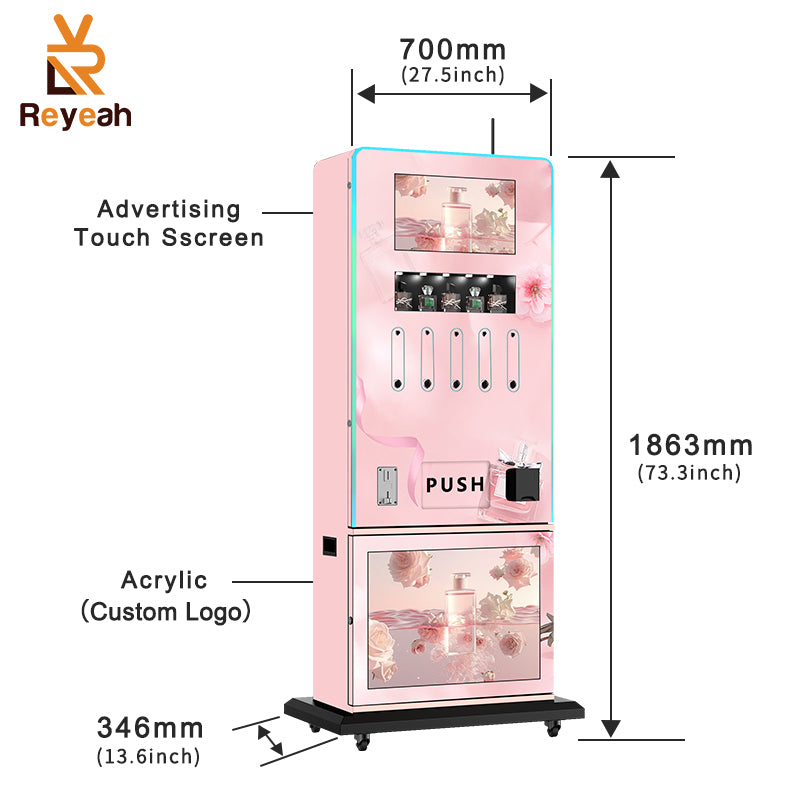
| Floor-standing with advertising display | 5–10 | Malls, airports, transit terminals | Tank capacity, dual-screen architecture, restocking interval |
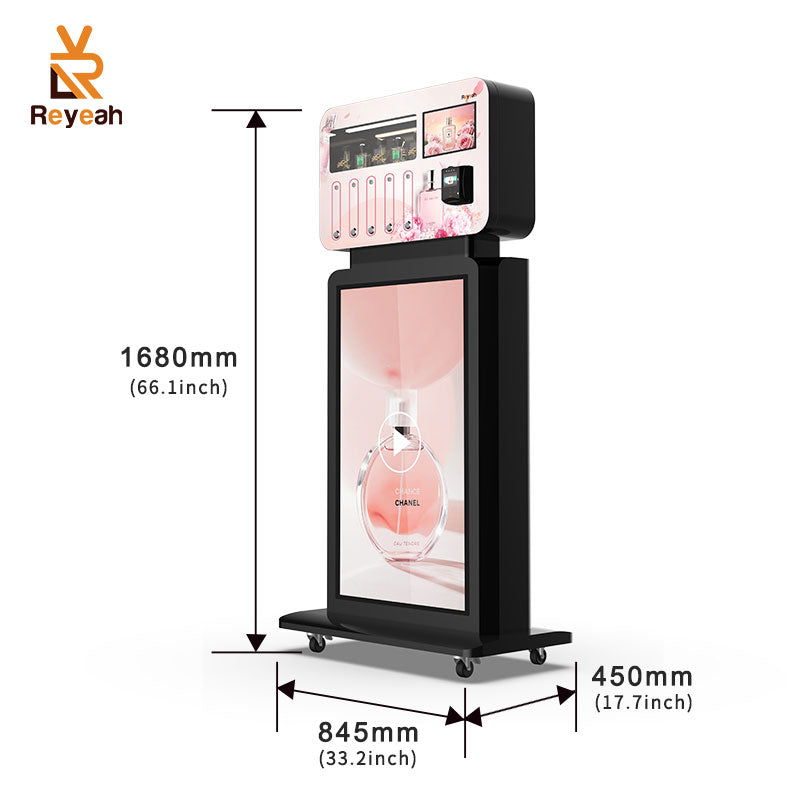
| Pedestal or base-stand variant | 5 | Retail floors where wall fixing is not permitted | Ballast and stability, cable routing, footprint |
When a perfume vending machine manufacturer says it builds both formats, ask for the installation drawing of each and the channel count per format. A factory that builds only wall units will quote a floor-standing machine by adding a pedestal — which is not the same product as a floor-standing machine engineered with a large reservoir.
What does a perfume vending machine factory actually have to engineer?
Six things, none of which appear in a photo of the cabinet:
- Atomization. The nozzle determines whether the customer receives a fine mist or a wet spurt. Reyeah's perfume range uses micro-atomization nozzles with dosage adjustable between 0.02 ml and 0.23 ml per spray; whatever a supplier's range is, ask for it in writing.
- Dosage calibration. Dosage is the operator's main cost lever: the same fragrance at a larger spray volume changes cost per spray, refill interval and the customer's perception of value.
- Fluid path materials. Fragrance concentrates contain alcohols and aroma compounds that attack the wrong elastomer. Seals, tubing and pump diaphragms have to be compatible, or the machine drips, clogs or contaminates the next fragrance.
- Reservoir design. Tank capacity sets the refill interval; tank geometry sets whether the last 10% is usable or wasted.
- Leak containment. A leak inside a machine with electronics is a fire and corrosion problem, not a cosmetic one. Ask where the fluid goes if a fitting fails.
- Hygiene and cleaning. Nozzles and lines need a documented cleaning routine, because a perfume vending machine dispenses a cosmetic product onto skin.
How do you verify a perfume vending machine manufacturer before ordering?
| Check | Evidence that counts | Why it matters here |
|---|---|---|
| Patents on the atomizer or pump | Certificate numbers with the supplier as applicant | Shows the fluid path is theirs, not a bought module |
| Calibration bench | Live video of a spray-volume test, not a marketing clip | Dosage accuracy is the product |
| Material compatibility statement | Named elastomer and tubing spec | Predicts leaks and taste carry-over |
| Nozzle and pump spares | Part numbers and lead time | A clogged nozzle is a routine failure, not a warranty event |
| Cleaning procedure | Written routine with interval and chemicals | Hygiene and clog prevention |
| Operator references | Two reachable customers running the model you are buying | Six-month behaviour beats a demo |
How do you compare leading Chinese perfume vending machine manufacturers and their products?
Put every offer on the same ten lines. A blank line is a question, not a zero:
| Comparison line | Record |
|---|---|
| Format | Wall-mounted, floor-standing or pedestal; installation drawing attached |
| Nozzle count | 5 or 10, with the fragrance menu that fits |
| Dosage range | Minimum and maximum ml per spray |
| Reservoir capacity | Litres per channel, and usable volume |
| Pump and nozzle type | Micro-pump model, nozzle material, replacement interval |
| Interface | Touchscreen size, or push-button panel; content update method |
| Payment | Terminal model, contactless, coin, bill — listed separately |
| Telemetry | Per-channel consumption, low-level alerts, data plan ownership |
| Warranty and spares | Inclusions, exclusions, nozzle and pump part numbers |
| Certification | Machine-level reports per destination market |
One metric exposes an unbalanced offer faster than the total price: price per nozzle. A 5-nozzle machine at a given price and a 10-nozzle machine at twice that price are the same unit economics — what differs is your fragrance menu and restocking labour.
What should you ask about fragrance compatibility?
Ask which fragrance families the supplier has tested, whether the tubing is rated for alcohol-based concentrates, and how the machine behaves when two fragrances share a nozzle line. Carry-over between scents is the most common quality complaint in perfume vending, and it is a plumbing question, not a software one. If you intend to fill with your own brand's juice, send a sample to the factory and ask for a compatibility statement in writing before production.
How Reyeah builds perfume vending machines
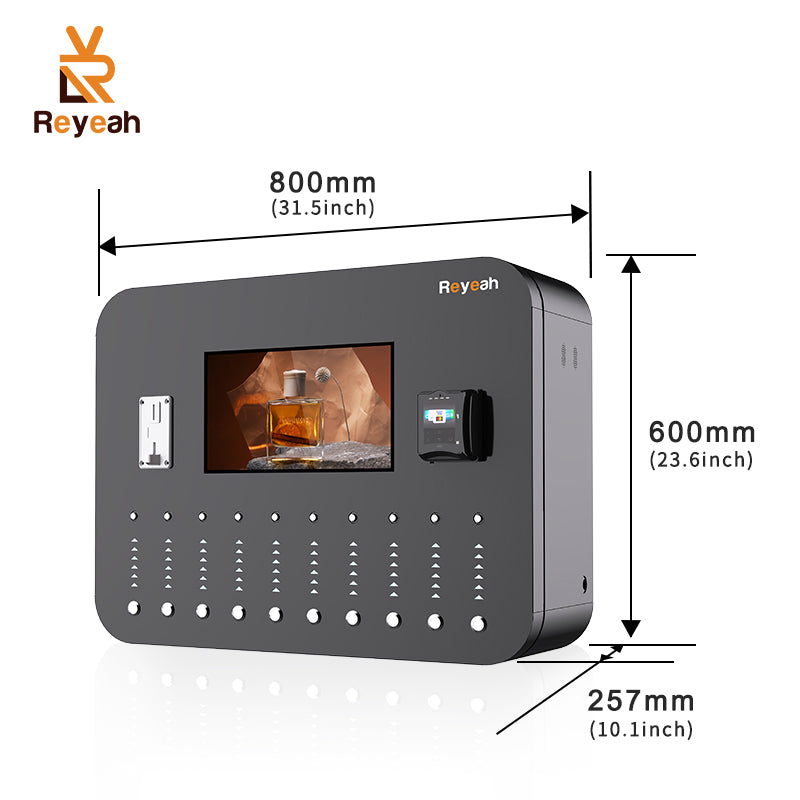
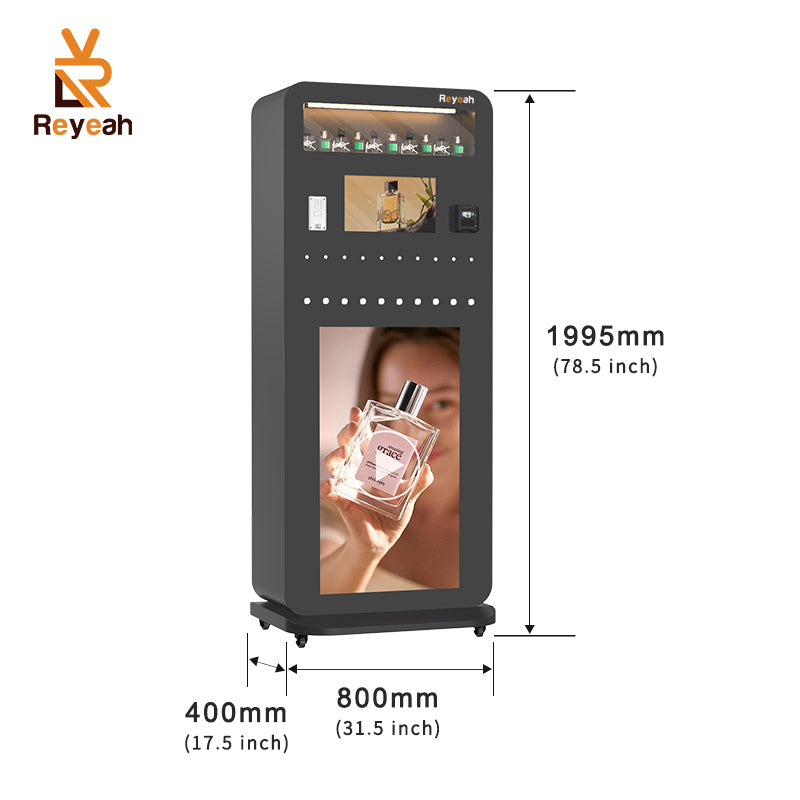
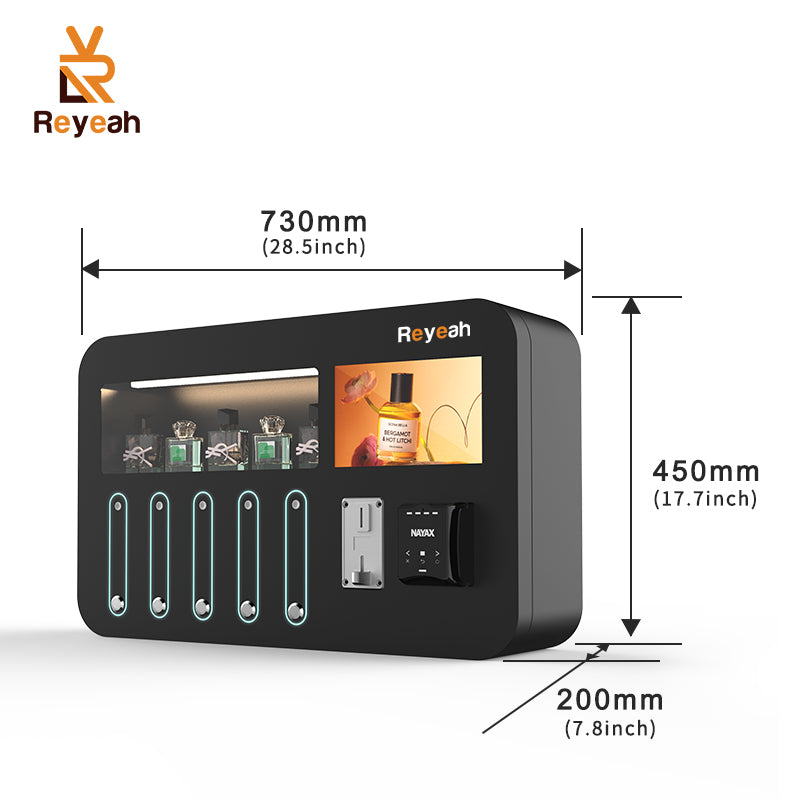
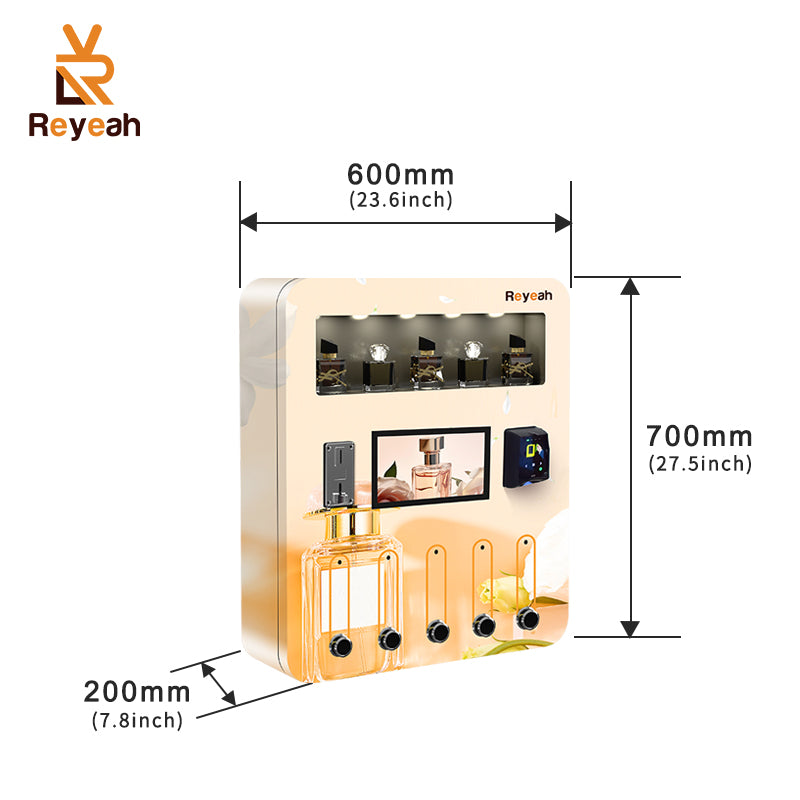
Reyeah is a perfume vending machine manufacturer based in Guangzhou, with more than 15 years in vending, 100,000+ machines a year, 300+ patents and a 50-engineer R&D team. The range covers both formats and both nozzle counts: the P03 with 10 nozzles, wall-mount or freestanding; the P13 floor-standing 10-nozzle kiosk with a dual-screen architecture for malls and airports; the P02 PRO wall-mounted 5-nozzle touchscreen unit; the P02 screenless push-button model for high-traffic, anti-vandal sites; the CUZ-024 700 × 600 mm wall unit with a central video screen; and the P12 luxury floor kiosk for hospitality interiors.
All of them share the same fluid-path engineering: micro-atomization nozzles with dosage adjustable from 0.02 ml to 0.23 ml, Nayax contactless payment with coin acceptance where the market needs it, and 4G/Wi-Fi telemetry with per-channel consumption and low-level alerts. Units ship with a one-year factory warranty, lifetime technical support and OEM/ODM options covering exterior, UI and fragrance menu.
Send your format, nozzle count, fragrance plan and destination market, and the quote will come back on the ten comparison lines above. Request a factory-direct quote.
FAQ
Who are the best perfume vending machine manufacturers in China? There is no credible published ranking. Screen them on four verifiable points: patents on the atomizer or pump, a live calibration test, a written dosage range, and nozzle spares with part numbers. A supplier that passes all four is a better bet than a larger one that forwards a brochure.
Do Chinese factories make both wall-mounted and floor-standing perfume vending machines? Most do, because the fluid path is shared. Confirm the installation drawing and channel count for each format, and check that the floor-standing version has its own reservoir design rather than a wall unit on a pedestal.
Are 10-nozzle machines better than 5-nozzle machines? Not inherently. Ten nozzles widen the fragrance menu and reduce the chance a customer walks away, but they also double the number of lines to clean and fragrances to stock. See the 5 vs 10 nozzle comparison for the economics.
What dosage range should a commercial perfume vending machine offer? Enough range to price different fragrance tiers: a small spray for a cheap scent and a larger one for a premium line. Reyeah units adjust from 0.02 ml to 0.23 ml; ask every supplier for its minimum and maximum in millilitres.
How long does a perfume vending machine last? The cabinet outlives the fluid path. Nozzles, pump diaphragms and tubing are wear parts; the honest question is how many cycles they are rated for and how quickly spares arrive.
Can I visit the factory before ordering? A serious manufacturer will schedule it, and a video walk-through of the assembly and calibration areas is a reasonable substitute for a first order. Refusal is information.